

Sentiwatt
Annour Mahamat Abdoulaye · iOS · Web · 2026
On the stores
AI predictive maintenance for industrial machines: IoT sensors listen to vibration and sound, a model flags failures before they happen.
- Released
- 2026
- Platforms
- iOS · Web
- Per prediction
- < 50 ms
- Bandwidth saved
- ~95%
- Offline buffer
- 10 min
Preview
Real screens from the product. Scroll sideways.
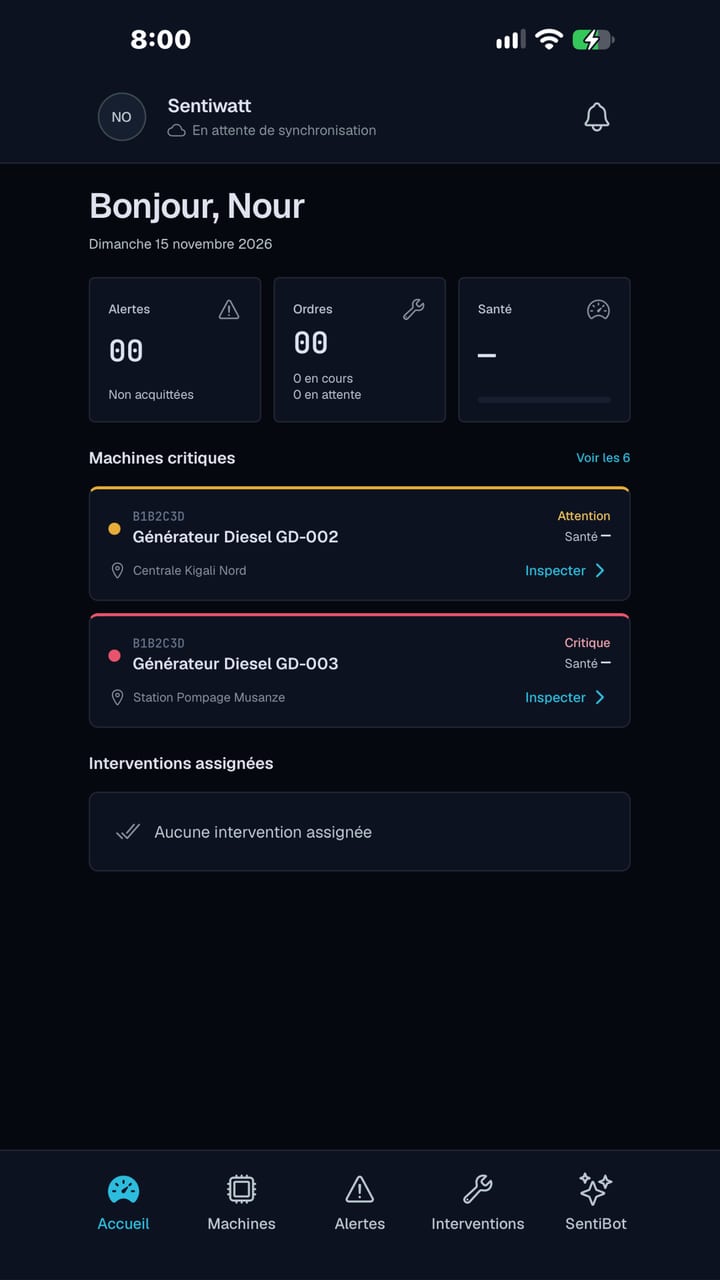 Home: unacknowledged alerts, work orders, and the machines that need attention first.
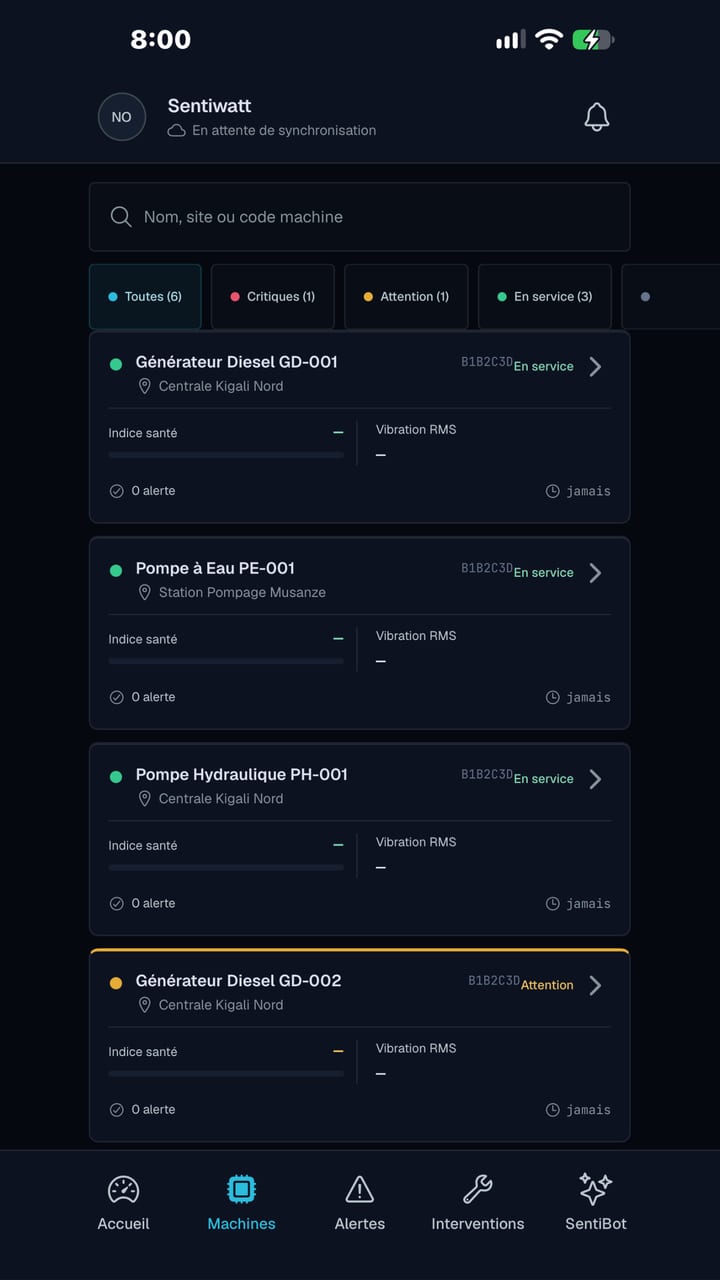 Machines: every unit with its site, health index, RMS vibration and status.
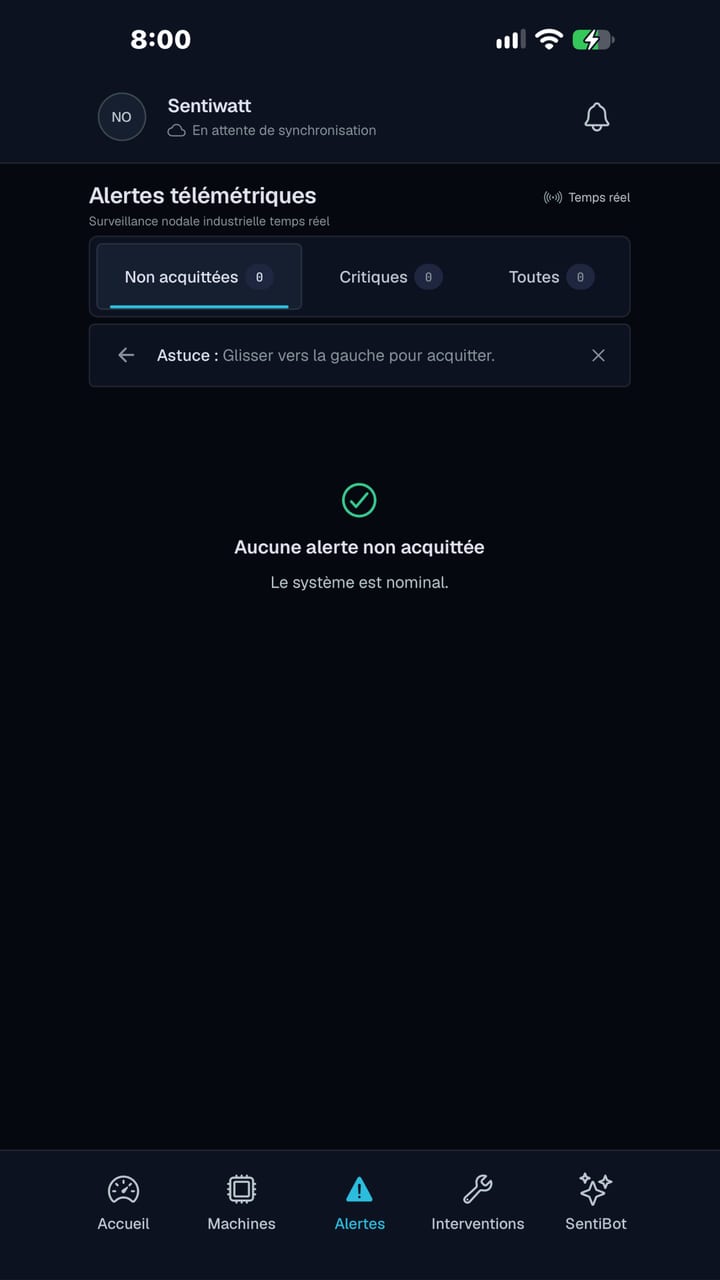 Telemetry alerts, filtered by unacknowledged and critical; swipe left to acknowledge.
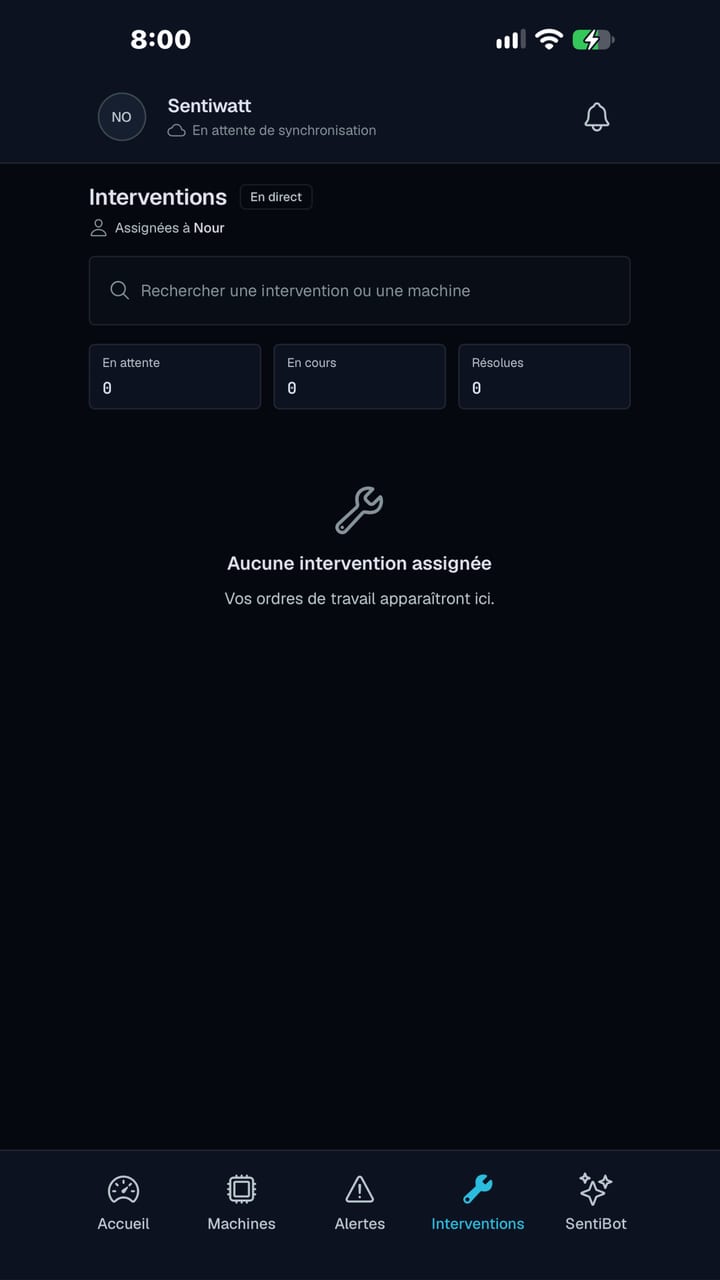 Interventions assigned to the technician, by status: pending, in progress, resolved.
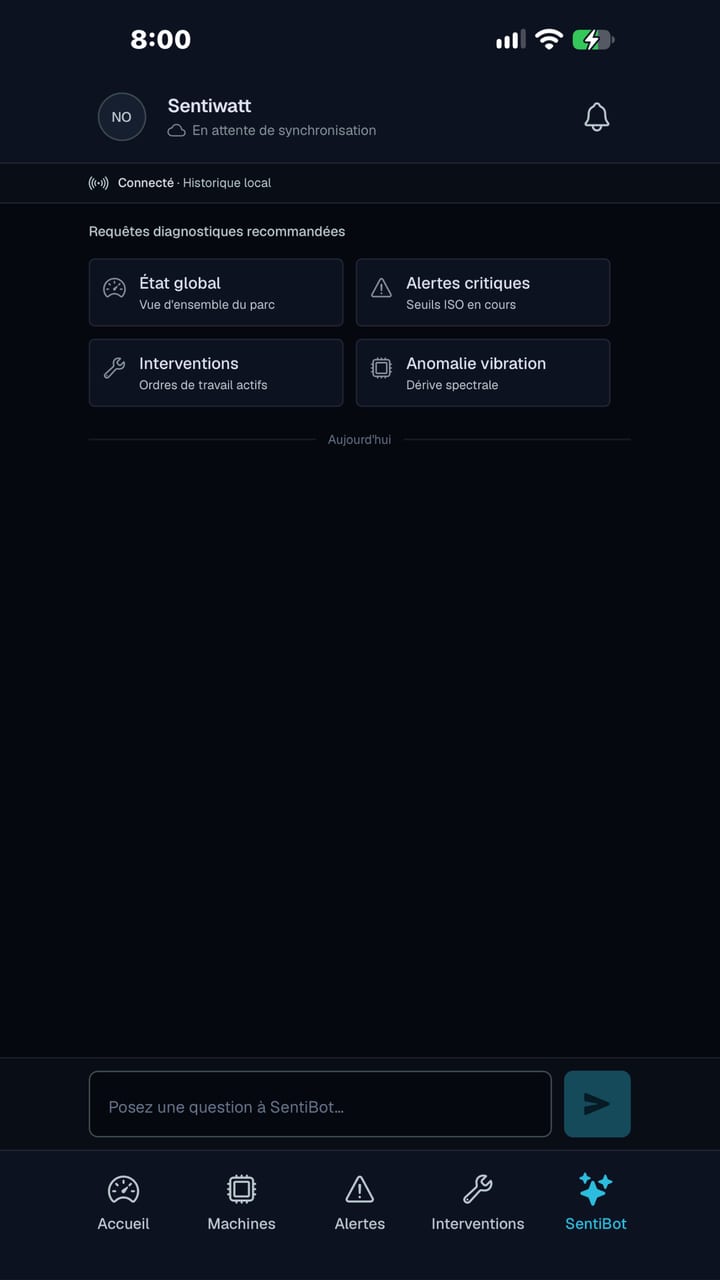 SentiBot: suggested diagnostic questions about the fleet, alerts and vibration drift.
About this app
End-to-end predictive maintenance ecosystem: ESP32-S3 firmware, a machine-learning pipeline, an inference service, a Next.js supervision dashboard and a React Native app for field technicians, in one TypeScript monorepo. Sensors capture vibration (MPU6050) and sound (INMP441) from generators, pumps and compressors; a 1D CNN classifies faults and an autoencoder detects anomalies; a critical score raises an alert, sends a push notification and opens an intervention before the breakdown. Final-year Software Engineering project at ULK, built to production level.
Who it's for. Maintenance teams running critical machines: electric generators, hydraulic pumps, compressors.
What it does
- Live fleet dashboard: KPIs, critical machines first, 24-hour vibration sparklines
- Machine detail with vibration RMS, sound level, AI health score and dominant frequency over 24 h to 90 days
- Alerts by severity, acknowledged with a swipe on mobile, turned into an intervention in one click
- Intervention workflow (pending, en route, in progress, resolved) with priorities, assignment and comments
- Push notifications to the site's technicians when a critical anomaly is detected
- SentiBot: questions in French about live data, answered through read-only SQL
- Offline mobile mode: SQLite cache and an outbox that syncs when the network returns
- Admin, manager and technician roles; reports exported to CSV or PDF
How it was builtThe need, the solution, the technical choices
- The need
- Critical machines fail without warning. Reactive maintenance means unplanned downtime, high costs and safety risks; calendar-based maintenance means interventions on healthy machines and parts replaced too early.
- The solution
- Predictive maintenance: sensors measure vibration and sound continuously, the AI turns the signal into a health score (healthy, at risk, critical), and a critical score raises an alert, notifies the site's technicians and creates an intervention.
- Where it is now
- Version 1.0 released on the App Store on 15 November 2026, with the web supervision platform live. Five deployable parts (firmware, ML pipeline, inference service, web, mobile) shipped by one developer as a final-year project at ULK.
Technical choices
- Edge computing on the ESP32-S3: RMS and FFT are computed on the device and a summary is sent every 2 seconds, about 95% less bandwidth than raw data. A full raw window goes up every 5 minutes for archiving and retraining.
- Two models: a 1D CNN classifies known faults, and an autoencoder trained only on healthy machines flags anything unusual (threshold calibrated at P99), so detection does not depend on labelled failures. Trained on the MAFAULDA and CWRU datasets, exported from PyTorch to ONNX.
- Inference in a separate FastAPI + ONNX Runtime service on Railway: CPU only, under 50 ms per prediction.
- Security in the database: PostgreSQL row-level security per role and site, and each device signs in with its own secret, so no Supabase key lives on the microcontroller.
- SentiBot runs Gemini over a read-only SQL function (SELECT only, 5 s timeout, RLS applied), so the AI can read the data but never change it.
- One pnpm + Turborepo monorepo with strict TypeScript and shared types between web, mobile and Edge Functions; CI runs lint, type-check, tests and deploy.
What's next
- Google Play release
- More machine types and sites
- Retrain the models on the raw windows collected in the field
More by this developer
View all 18 projects- TauxLiveReal-time currency converter with parallel market rates and mobile money transfer fee comparison across 31 currencies, 15 of them African.On the stores
- AfriStackProduction-ready MoMo templates. Stop losing 3 days to Mobile Money integration.Live
- GriotAI-powered portfolio platform for African developers with GitHub aggregation and Claude AI bio generation.Live